 July 3, 2026
 Categories: Arts
Behind the Hits: Uber-Composer Yitzy Waldner Finally Takes the Mic
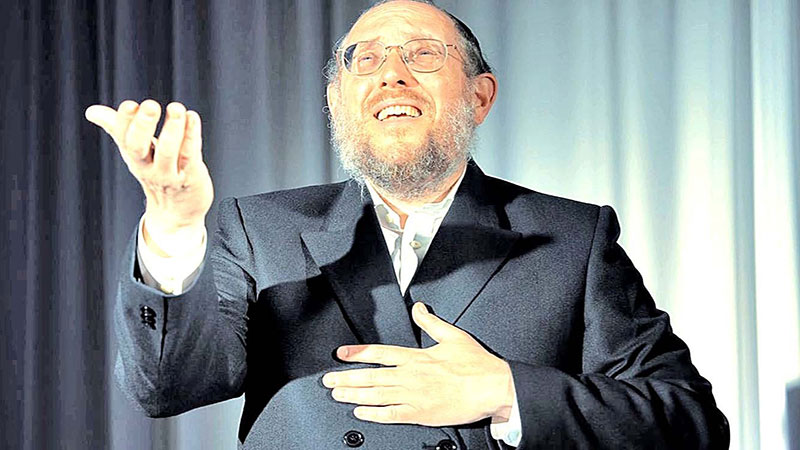


He has already composed hundreds of songs, some of which have become big hits in Jewish music over the years. In fact, there is a good chance that you are familiar with some of his hits, even if you didn’t know who composed them. He’s one of the most prominent composers in Jewish music, having impacted and shaped chassidic music as we know it. Among his hits are “Bring the House Down,” “It’cha Ani,” “Recalculate,” and “K’shoshana,” performed by Avraham Fried; “Charasho,” performed by Benny Friedman; and Yaakov Shwekey’s “Meheirah,” “Ani Ma’amin B’nisim,” “Et Rekod,” and even “Libi BaMizrach.” Honestly, I would probably never have guessed that “Libi BaMizrach” was composed by a chassid from Lakewood. It’s one of my favorite songs, and it sounds like a typical Israeli Mizrahi song. And besides the hits I just mentioned, there are so many more that it would probably take up most of this column if I were to mention every one of them.
We are talking about Yitzy Waldner.
“Ani Ma’amin B’nisim” (I Believe in Miracles), which he composed many years ago for Shwekey, is still being played at weddings. So, the first question I ask Waldner when we speak is: “Do you believe in miracles?”
He laughs – he understands why I’m asking.
He recalls that several years ago, Shwekey performed at the Kotel on Yom Yerushalayim. After the performance, he sent Waldner a video of about 150,000 Israelis – a mix of chassidim, Dati Leumi, charedim, and Masorti – all standing and singing together “Ani Ma’amin B’nisim!” If anything brings Waldner pure nachas, it is this video. This song, which took him maybe one minute to compose, truly inspires people all over the world.
And yes, he says, everything is from Hashem.
He always enjoys seeing people enjoy his music, and he receives emails from all over the world. It’s a big zechus that Hashem gives each person their own unique gift. For example, the song “Bo’ee B’shalom” from the album Libi BaMizrach has caught on all over the world. Even non-frum people love the song.
Waldner shares a story about the song with me: A few years ago, he ran a side business selling items on Amazon. One day, he got in touch with one of his suppliers, an Israeli man. While speaking on the phone, the supplier asked if it would be okay to bring his girlfriend, who was his fiancée at the time, when he came over. They finalized the deal, and the Israeli supplier drove to Waldner’s house to deliver the goods along with his fiancée, who was also Israeli.
When they arrived, the woman noticed his keyboard and asked if he plays for children or something similar. Waldner replied that he doesn’t really perform but is actually a composer. He then asked her if she had ever heard of Yaakov Shwekey, since he had composed many songs for him. He assumed even a secular Israeli might be familiar with Shwekey as his songs have been very popular in Israel. She said she had not.
Waldner began to sing one of the songs he composed for Shwekey – “Bo’ee B’Shalom.” Suddenly, as he was singing, he noticed the woman’s eyes filling with tears. Confused, he asked her if everything was OK.
She told him that when her sister got married a few years prior, that exact song was played as her sister walked toward the chuppah. She had loved the song so much that she promised herself she would walk down the aisle to it on her own wedding day. Now that she was engaged, she was already planning to use it, so hearing him sing it out of nowhere made her incredibly emotional.
“I composed this song,” Waldner told her. Everyone was amazed. What are the chances that out of all the people in the world, they would deliver goods to an Amazon merchant who happened to be the composer of that exact song?
Long story short: She did indeed walk down the aisle to her chuppah to this song, and today, the couple has become closer to Yiddishkeit (though not strictly because of the song...).
I ask Waldner about one of my favorite Avraham Fried albums, Bring the House Down, for which he composed many of the tracks. Specifically, he composed the title track as well as “It’cha Ani,” “Otzar Shel Yiras Shomayim,” “Kaparah,” “K’Shoshana,” and “Recalculate.”
I mention to him that this album sounds distinctly different from Fried’s earlier work. While previous albums followed a more classic chassidic arrangement – utilizing the “standard” formula of brass intros, strings, piano, and electric guitar – Bring the House Down feels much more dance-oriented, driven by electronic beats. Some tracks, like “Kaparah,” even venture into a Mizrahi style. I ask him if this shift was intentional.
“I have composed about 500 songs,” Waldner replies. “I always try to change. I don’t want people to instantly know or think that they were all written by the same composer. I want to keep things interesting. If you do the exact same thing every time, where is the chiddush (novelty)?”
To illustrate his point, he brings up the title track, “Bring the House Down.” He recalls what Avraham Fried told him at the time: “I want the Beit HaMikdash to come down. Now! I want the Beit HaMikdash! Let’s bring the House down!”
“A concept like that,” Waldner explains, “is not a simple thing. It’s not meant to be a quiet song. When you ‘bring the house down,’ you make noise. You show honor… We are bringing the Beit HaMikdash down right now. That’s why the song begins the way it does – with a powerful opening, heavy drums, and an energetic intro. We are bringing the house down – we are going to celebrate tonight.”
However, Waldner emphasizes that the underlying message and melody remain paramount. “It’s crucial to have harmony beyond the beat. When you have real harmony, it speaks directly to the heart.”
This drive to innovate and avoid predictable patterns defines Waldner’s style. He shares an anecdote from when Yaakov Shwekey released the album, Libi BaMizrach. People asked Shwekey if the tracks had been composed by a typical Israeli composer from Tel Aviv. Shwekey laughed and replied, “No, it was actually composed by a Bobover chassid from Lakewood who wears a shtreimel on Shabbos.” People could hardly believe it.
Waldner notes that he particularly likes songs in major scales – the kind of uplifting music played at chuppahs. It’s also important to him to have a message in the song.
But even when he pushes the boundaries, it’s not that his music will sound “non-Jewish” or like club music; he simply wants his music to be interesting. He wants to send a message. With every generation, the boundaries shift. The question is, what do you do with the influence? He quotes the phrase “Omnam hakol hevel,” translated as “Though all is vanity,” but hevel is also an acronym for Hakol Barah Lichvodo (Everything was created for His glory). There’s a purpose to his music: to awaken the hearts. Music is a dress, a vessel to inspire people to listen to the message of the songs.
“What comes first?” I ask him. “The melody or the words?”
“What gives the inspiration is the words,” he says. Even if you don’t have all the words yet, having an idea is already a start. Sometimes, though, he will compose a melody without any words.
“Where do you get your inspiration from?” I ask.
“You have to be in a place of joy,” he answers. He noticed, for example, that during Covid, he didn’t compose a single song. When there are troubles and crises in life, just like anyone else, he simply cannot compose. If he is in a place of happiness, it just flows out of him like water from a faucet. He has to be in a good mood, in a state of happiness. If he’s not in a good mood, he can’t compose – he doesn’t even try.
He told me, however, that while he can compose from a place of sadness, he cannot compose from depression. He makes a clear distinction between sadness and depression. When his grandfather passed away about 25 years ago, he composed the song “Al Naharos Bavel” the very next day. “Depression is not tears,” he explained. “It’s a mental state.” While we’re speaking, he mentions that yesterday was actually his grandfather’s yahrzeit.
Waldner explains that while there are inherent patterns and rules to composition, they are not set in stone. Take, for instance, the difference between major and minor scales. Generally, minor scales lend themselves to quiet, melancholic, and deeply moving melodies, whereas major scales drive happy, upbeat songs. Yet this rule is highly flexible.
He points to “Meheirah,” a masterpiece he composed for Shwekey’s Shomati album, which remains a wedding staple to this day. Shortly after the song was released, a chassid at his synagogue approached him with a flurry of questions: “Did you get the idea for this song from the radio? Do you listen to secular music? Were you influenced by non-Jewish music? The song sounds goyish.” Waldner took no offense. He knew, of course, that his inspiration hadn’t come from the radio.
So how can a song in a major scale, like “Meheirah,” be so quiet and touching? As another example, he mentions “Tefillat Hashlah” (from Shwekey’s album Musica), which is also written in a major scale and is deeply moving. The answer is that these songs are not sad. They might bring you to tears, but tears do not always mean sadness. There are tears of happiness, and there are tears of hope. “Tefillat Hashlah” may be quiet and heartfelt, but it also inspires hope.
To prove his point, he highlights that the traditional melody for the YomKippur confession prayer, “Al Chet,” is written entirely in a major key. A major scale can be quiet and soulful, yet leibedik. He points to other High Holiday prayer melodies that use major scales, such as the familiar niggun the chazzan sings right before Barchu.
Another thing I’m curious about is what it’s like to be behind the scenes of the most famous and popular albums – the iconic albums of Shwekey, or Bring the House Down by Avraham Fried? People usually know the singer, not the composer.
Waldner actually likes the anonymity. He wants to remain a private person. He wants to go grocery shopping quietly, without people recognizing him on the street. However, over the last couple of years, with social media use increasing, that is no longer the case. People already know him. They post statuses and photos, and people recognize him.
As a result, he recently began releasing his own songs which he sings. Since social media made him lose his anonymity anyway, he figured he might as well sing himself. It also brings in extra income. In Chassidut, the goal is to bring the world closer to Hashem. If he can do it with his own voice, he’s willing. He sees how his music influences people.
Waldner grew up listening to Mordechai Ben David, Avraham Fried, and Dedi Graucher, z”l. He even composed four songs for one of Dedi’s albums. He also listened to Shlomo Simcha, Pirchei Miami, and various Bobov songs. As I mentioned, Waldner himself is a Bobover chassid. The songs sung at the tisch, the songs he heard in school – they all influenced his music. As a child, he was even part of the Amudai Shaish Choir.
And now to the questions I like to ask musicians on my journey to understand what Jewish music really is.
Why is Jewish music so often identified with simple scales?
“The songs in Eastern Europe were very simple,” Waldner explains. “They were songs that spoke straight to the heart, that woke up the heart. And songs that awaken the heart don’t need a lot of information. The main thing is the words – to tell a story. How hard life is, what it means to live in Europe in galus. The shtetl songs are simple – they sang about their lives and their difficulties. Furthermore, the non-Jewish music in Eastern Europe was also relatively simple, which naturally influenced Jewish music. By contrast, the music of Spanish Jews was much more complex because it was influenced by Spanish music, which is intricate, using quarter tones and so on.”
“What is Jewish music?” I ask.
“To answer this question,” he says, “you first need to answer another question: What does it mean to be a Jew?”
He notes that the Shulchan Aruch writes that every morning, one should “wake up like a lion to do the will of our Father in Heaven.” The Mishna Berurah notes right there: “Because for this you were created – to do the will of our Father in Heaven, to study Torah, to do acts of kindness, and to create a sanctification of G-d’s name (Kiddush Hashem).” Now, once you understand what a Jew is, you can understand what Jewish music is, Waldner says.
“If music awakens the heart, if through it you can draw a person closer to serving G-d, to praying better, with more kavanah, or to bringing joy to a Jew in distress – if the music brings true joy – then it is Jewish music,” he says. He adds that in Lashon HaKodesh, the word ‘fun’ does not even exist. In Lashon HaKodesh, there is only simcha. The goal is not to listen to music just for fun in a club – that is not Jewish music. But if the music brings joy to a bride and groom, it is Jewish music. If it makes a random Jew happy in the middle of the day, it is Jewish music.
He shares a fascinating story that someone once told him: He worked with a very successful lawyer who ran a major firm. This lawyer was a very tough person who never showed emotion, which is probably why he did so well in business. One day, the man entered the office and saw this tough lawyer sitting there crying. The colleague was completely confused – he never expected this from this man. The lawyer called him over and said, “Come, sit.” Then he played a song. The song was “Shema Yisrael” by Yaakov Shwekey – which Waldner had composed.
Music truly has the power to influence people. Even the toughest among us.
“What do you think about the new trend of dance and trance in Jewish music?” I ask.
“The question is, when you listen to this music, when you dance to it, does it bring you closer to Hashem?” Waldner answers. “If you listen to it just because you heard that style in a club, then no, that is not good. But if it touches you, if there is a message, then it’s OK. You can use technology and modern sounds, but if it’s only about the technology, only about the beat, then no. If the song has a Jewish message, if there is something beyond the electronic beat, it’s fine. If there is no soul in the song, then it becomes a problem.
“For young people today, that beat is almost like a drug. It needs to have a strong message so it still sounds Jewish. It should have harmony, melody, and it should touch the soul. It should be the spice, not the main dish. Don’t overdo it. You need to know how to mix it.”
Is it easier or harder today for a beginner artist to become the next Shwekey?
“What was easy back then is hard today, and what was hard then is easy today,” Waldner reflects. “When Shwekey started, there weren’t many singers, so it was easier to stand out. However, marketing and promotion were much harder. In the early 2000s, promoting yourself was incredibly difficult and expensive. You had to physically print CDs and ship them to stores all over the world. The logistics were a nightmare.
“Today, on the other hand, there are countless singers, but promotion is incredibly easy. We have social media. With the click of a button, your music reaches the entire world, and if it succeeds, it can hit millions of views. Today, the real money comes from gigs – weddings, chuppahs, events. You don’t really make money from streaming; you get fractions of a cent per play. You need millions of streams just to make a profit. So, while it’s much easier to distribute and promote because everything is digital, there is also vastly more competition.”
That, by the way, is exactly why Jewish music is shifting toward EDM. Artists want to reach the youth, and they want more views and likes.
Yitzy Waldner is available to sing at simchas, specializing in chuppahs, and at other special events. His music can be found on all streaming platforms.