 July 3, 2026
 Categories: Op-Eds / Perspectives
Political Violence: The Weimar Warning
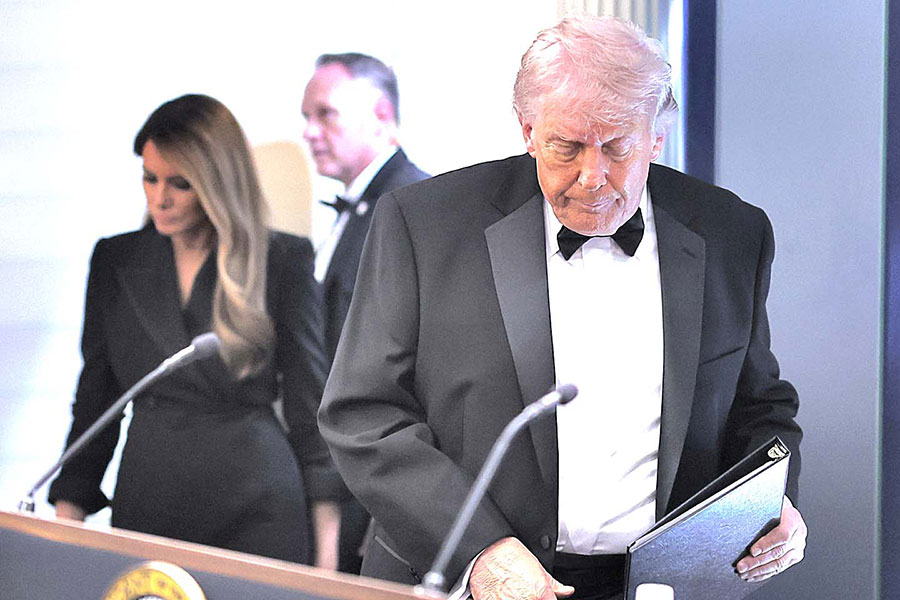


It happened again – another Trump assassination attempt.
It’s only a matter of time before online extremists, on the right and the left, blame Israel or “Zionists.”
Already, some voices claim the incident at the White House Correspondents Dinner was staged – a false flag attack.
Already, lunatics on the left – and their media allies and enablers – are quoting from the gunman’s crazed, anti-Trump manifesto as if it was political commentary.
So it goes nowadays.
We are living through the worst period of political violence and extremism – and overt antisemitism – since the 1930s.
On the right, openly extremist candidates – including some with neo-Nazi affiliations – have entered Congressional races.
Tucker Carlson – an isolationist, Israel-bashing, former Fox News host with millions of social media and YouTube followers – has only become more popular by conducting creampuff, “just asking” interviews with a notorious Jew-hating white supremacist and a podcaster who called Winston Churchill the chief villain of World War II and described Nazi atrocities as logistical accidents.
On the left, Hasan Piker, a Marxist streamer who calls Zionism a racist ideology, says the Jewish State has no right to exist, regardless of its size or borders, and has told his audience that Hamas is “one thousand times better than Israel,” isn’t shunned by the Democratic Party but courted by it. Politicians and former Presidential advisers line up to appear on his online program. California’s Governor Gavin Newsom, a leading contender for the Democratic Party’s 2028 Presidential nomination, is receptive to appearing on it.
These are the signs of our times.
The most dangerous feature of the moment isn’t merely the resurgence of antisemitism. It is its reappearance from both ends of the political spectrum, simultaneously, and with increasing intensity.
On the right, antisemitism appears in its older language: blood, soil, race, replacement theory, globalist conspiracy, dual loyalty.
On the left, antisemitism appears in newer, “intersectional” language: anticolonialism, anti-Zionism, “resistance” and liberation – and the recasting of Jews as oppressors.
The language differs, but the function is identical. Both extremes turn Jews into symbols of the despised center.
Which is why serious students of politics – and especially American Jews – would do well to read some 20th century German history, more specifically, the history of the Weimar Republic, Germany’s first democracy.
Germany in the 1920s, not America in the 1930s, is the best example of rightwing and leftwing extremism effectively collaborating to tear a society apart. It’s true that America in the ‘30s was plagued by an array of antisemitic, racist and pro-fascist organizations, including domestic terrorist groups like the Ku Klux Klan and the Black Legion that enjoyed support from local law enforcement agencies.
The Catholic priest Father Coughlin used radio to reach up to 30 million weekly listeners with his mix of explicit antisemitism and praise for Hitler and Mussolini. And the celebrated aviator Charles Lindbergh – the most famous public face of the isolationist America First Committee – openly admired and visited Nazi Germany while accusing Jews of pressing America toward war. In 1938, he accepted the Service Cross of the German Eagle from Luftwaffe chief Hermann Goring – a high Nazi honor personally approved by Hitler.
But despite their numbers and influence in industry and finance – there was even an anti-FDR, failed fascist coup plot backed by wealthy businessmen – America’s 1930s rightwing extremists never came close to seizing the levers of power. And the country’s Communist Party opted – under Soviet direction – not to oppose Roosevelt and the New Deal but to work within the American political system to increase the party’s power and appeal.
What happened in Germany was decidedly different.
Before examining the Weimar Republic’s downfall, it’s important to take note of its achievements. The Republic produced one of the most dazzling cultural flowerings in modern history, and its constitution, drafted in 1919, was a model of liberal democratic principle: universal suffrage, civil liberties, proportional representation, an independent judiciary.
Germany's Jews, who had been emancipated for barely half a century, were woven into the fabric of the culture at every level.
And then it was gone.
In 14 years, the Republic went from promise to ruin, and in less than a decade more, six million Jews – including 1.5 million children – were dead.
To be clear, the America that celebrates its 250th birthday this year is not Weimar Germany. America has deeper democratic roots, stronger institutions, a more diverse and resilient economy, and a constitutional tradition that Weimar never had time to develop.
But that is precisely the wrong way to read a historical warning. The value of the Weimar Republic as a case study lies not in its similarities to our moment but in its mechanisms – the observable ways a functioning democracy can be hollowed out from within.
Weimar shows what happens when extremists on both flanks treat the moderate center as the primary enemy. It shows how political violence, normalized gradually, stops shocking anyone, how a free press, a brilliant culture, and a cosmopolitan urban life can coexist with – and even mask – the accelerating rot of democratic norms.
None of those mechanisms require a lost world war or a wheelbarrow full of worthless currency to operate. They require only opportunity and a dangerous level of social disintegration.
The most important and least understood feature of the Weimar Republic’s collapse was that it was attacked simultaneously from both ends of the political spectrum – and that the attackers cooperated when it suited them.
The Communist Party of Germany, taking orders from Moscow, embraced a concept called “social fascism.” Under this theory, Germany’s Social Democrats – the moderate left that was the backbone of the Republic – were cast not as natural allies against the Nazis but as the primary obstacle to a Communist revolution.
The Social Democrats were denounced as “social fascists” accused of being worse than the actual fascists for giving the working class the illusion of democratic representation. The Communists’ strategic imperative was to destroy the center before confronting the right.
In 1931, the Nazis proposed a referendum to dissolve the Social Democratic government of Prussia, the largest German state and the institutional heart of the Republic. The Communists joined them, providing signatures and campaigning alongside Nazi stormtroopers. The referendum failed, but not before the two most violent anti-democratic movements in Germany demonstrated they could act in concert against the Republic.
Their cooperation reached its grotesque apex in November 1932, during the Berlin transport workers’ strike. Communist union members and Nazi stormtroopers manned the same picket lines and attacked the same Social Democratic strikebreakers.
Communists and Nazis backed a Berlin rent strike together under the slogan “Food first, then rent!” Nazi and Communist flags hung from the same buildings.
The Communist logic was that a Nazi government would be so intolerable it would finally radicalize the German working class and produce the revolution.
“After Hitler, our turn,” was the Communist slogan.
We know how that turned out.
The policy, dictated by Stalin, had deep roots. In 1923, Communist leader Ruth Fischer addressed Nazi students in Berlin and tried to win them over to the Communist cause – with antisemitic rhetoric.
“Those who call for a struggle against Jewish capital are already class strugglers,” she said. “You are against Jewish capital and want to fight the speculators. Very good. Throw down the Jewish capitalists, hang them from the lamp-post, stomp on them. But, gentlemen, what is your position with respect to the big capitalists?”
(The daughter of a Jewish philosophy professor, Fischer eventually broke with Stalin and, after settling in the United States, became an undercover agent of a small, secret U.S. intelligence agency, The Pond, which operated between 1942 and 1955.)
Soviet foreign policy reflected the antidemocratic party line. From the early 1920s until 1933, when Hitler took power, Moscow secretly aided German military rearmament in violation of the Treaty of Versailles. German rightwing groups, particularly paramilitary reserve units and nationalist military leaders, played a central role in the secret rearmament program; and conservative industrialists collaborated with the military.
Following the infamous Molotov-Ribbentrop Pact of 1939, the Soviet Union provided the Nazi Kriegsmarine with economic support and a naval base for about a year – aiding the enemy it would fight in the coming conflict that would cost the lives of more than 26 million Soviet citizens.
Weimar's political violence – like its illicit arms buildup – was incremental. The Nazis and the Communists waged a years-long campaign of street battles, assassinations, and political intimidation that the Republic's institutions absorbed, rationalized, and ultimately failed to suppress. Each incident, taken alone, could be contextualized, minimized, explained away. The result was the emergence of a society losing the monopoly on legitimate force that defines a functioning state.
America has its own version of this normalization. A Congressman shot at a baseball practice. The home of a Jewish governor firebombed on Passover. Pipe bombs at party headquarters. Israeli Embassy employees shot to death on a Washington street. Jewish students harassed and assaulted on campuses by pro-Hamas demonstrators while administrators issue carefully balanced statements. Jewish-owned businesses vandalized and physically blocked by pro-Hamas demonstrators.
And then Luigi Mangione, the accused killer of United Healthcare CEO Brian Thompson. The open celebration of political murder by a significant slice of the American public... the meme culture that made the suspect a folk hero overnight... the politicians who refused to unambiguously condemn it... this is what normalization looks like in its early stages.
Each incident gets processed as isolated. That refusal to see the pattern is itself a Weimar mechanism.
In every country where political extremism has metastasized into catastrophe, Jews have been the first target. Not because Jewish communities are the largest or most powerful segment – Jews constituted less than one percent of Germany’s population in the 1930s – but because antisemitism is the most available, historically loaded form of scapegoating, the kind that can be deployed from the right and from the left simultaneously.
The current convergence of far-left and far-right hostility toward Jews under different rhetorical frameworks is a Weimar phenomenon. The Communists attacked Jewish “capitalists” and “bankers.” The Nazis called Jews both bankers and “Bolsheviks.”
Listen to Tucker Carlson – our era’s Father Coughlin – and Hasan Piker on the American-Israeli strikes against Iran. The rhetoric is nearly identical: a corrupt American establishment, captured by foreign and domestic Jewish interests, dragging the country into a war it doesn’t want.
Those who reflexively say it can't happen here, whether speaking of Weimar-level antisemitism, political violence, or the collapse of democratic norms, should consider a scenario that Germany faced and America has never faced – namely, a deep depression coupled with hyperinflation.
The distinction matters. America’s Great Depression was a deflationary catastrophe. Prices fell; the dollar gained in purchasing value even as wages and jobs vanished. That dynamic, perversely, imposed a certain limit on social desperation. Money, for those who had any, was real.
An inflationary depression is something else entirely: mass unemployment combined with a collapsing currency. People find themselves in a world where they have no work and their money is worth less every week.
We don’t know if American democracy can survive that. We have never had to find out.
In Germany, the hyperinflation of 1921 to 1923 didn’t just impoverish Germany; it pauperized the very class that had believed most deeply in order, savings, education, respectability, and the rule of law.
In 1923, the mark collapsed so rapidly that prices changed by the hour; workers were paid twice a day, restaurant prices rose while customers were still eating, and by November it took roughly 4.2 trillion marks to buy one American dollar.
The catastrophe wiped out pensions, savings accounts, insurance policies, government bonds, and the accumulated security of a lifetime. Debtors, speculators, and those with real assets could survive or even profit, but salaried professionals, civil servants, teachers, clerks, pensioners, and small savers were humiliated and ruined.
The result was not only economic distress but moral and political radicalization. Millions of Germans concluded that the old virtues had become a fraud. Thrift was punished, prudence was mocked, and the government had presided over the confiscation of their lives.
Hyperinflation destroyed the middle-class faith that democratic normalcy could protect them. Once that faith was gone, the promises of the extremes became easier to hear.
The disillusioned middle-class members did not turn to Communism. The middle class turned to National Socialism, becoming one of the regime’s most reliable constituencies.
The lesson is not that economic suffering automatically produces fascism. It is that economic suffering of sufficient depth and suddenness – suffering that feels like a betrayal by the institutions one trusted – destroys the social faith on which democratic politics depends. And without that social faith, the demagogues who promise to identify the betrayers and punish them find a ready audience.
Institutional faith is the other casualty. Weimar's courts routinely imposed light sentences on rightwing political violence while prosecuting leftwing defendants harshly.
The Republic's police forces were riddled with monarchist and proto-fascist officers who shared the politics of the movements they were supposed to suppress.
The press was vibrant and diverse – and utterly incapable of supporting a stable center because there was none.
By the time the crisis arrived, the institutions that were supposed to defend the Republic had already been weakened and shredded beyond repair.
The Weimar Republic's moderate majority believed, until very late, that the institutions would hold, that the constitution would protect them, that the extremists on both flanks were too absurd, too violent, too obviously dangerous to ever capture the country. They believed the center was solid.
It was – as solid as a block of ice melting in the summer sun.
The lesson is simple. Extremists don’t need to agree with one another to destroy the center. They need only agree that the center deserves to be destroyed.