 July 10, 2026
 Categories: Headline / Perspectives / Op-Eds
The Iran War’s Unanswered Questions And Washington’s Fear of Victory
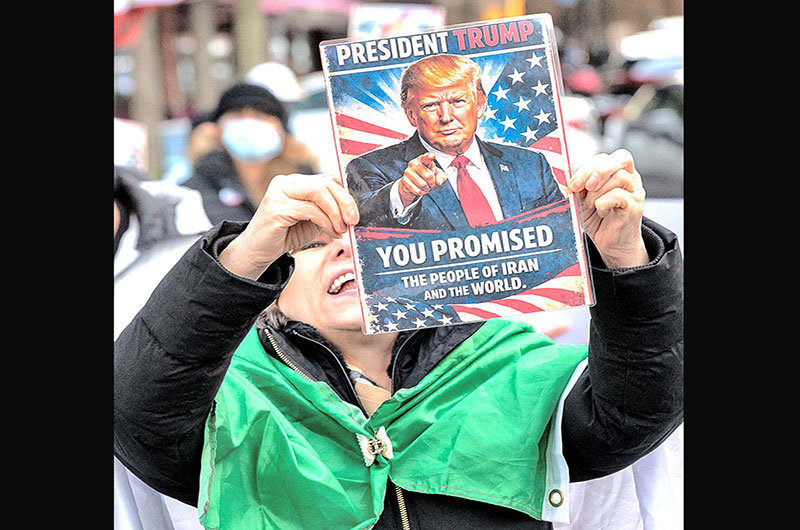


The most important question raised by the Iran war isn’t a military question. It’s political.
Why did the United States intervene after the Iranian people had been defeated rather than when they were still fighting for their freedom?
That question leads directly to a series of others about timing, strategy, objectives, and the limits the U.S. and its allies imposed upon themselves. The purpose of this article is not to answer those questions, but to ask them.
The Missed Moment?
When hundreds of thousands of Iranians poured into the streets during the regime’s mass crackdown, they were not simply protesting economic conditions. Many believed they were participating in a genuine challenge to the Islamic Republic itself.
At the time, President Trump publicly encouraged the demonstrators, condemned the regime’s violence, and suggested that America would not stand idly by while thousands of Iranians were being killed.
Many protesters drew hope from those statements. Some later said they believed outside help would arrive if the regime crossed certain lines.
Those lines were crossed repeatedly.
Thousands were killed. Tens of thousands were arrested. The uprising was crushed.
Only later came military action.
That sequence raises an uncomfortable question. Would a limited use of force tied directly to the uprising have had a greater chance of splitting the regime’s elites and security services than a conventional air campaign launched after the Revolutionary Guard had already demonstrated its loyalty and ruthlessness?
Perhaps the most important unanswered question of the entire war is whether the decisive moment came before the bombing began.
Was the War Fought on Iran’s Terms?
By the time war arrived, Iran was no longer a regime under acute domestic pressure. It was a regime that had survived a major internal challenge and emerged hardened by repression.
The Revolutionary Guard had restored control. The opposition had been driven underground. The regime’s network of tunnels, hardened facilities, missile complexes, and regional proxies remained largely intact.
For decades Iran had prepared for exactly this kind of confrontation.
Did the failure to act during the uprising mean that any subsequent war would necessarily be fought against the strongest and most prepared version of the regime?
And did that reality impose limits on what Washington and Jerusalem believed they could achieve?
Why Was the Television Network Allowed to Survive?
One revealing question concerns Iran’s state broadcasting system.
The regime’s television network isn’t merely another government institution. It’s one of the principal instruments through which the Islamic Republic shapes public opinion, controls information, and projects authority.
Although parts of the broadcasting complex reportedly suffered damage during the war, the system continued operating. Viewers continued seeing familiar presenters assuring them that victory was near and that little of consequence had changed.
There may be valid military, legal, and political explanations. Yet the question remains.
If command centers, intelligence facilities, missile sites, and Revolutionary Guard bases were legitimate targets because they sustain the regime, why was one of the regime’s most important instruments of political control apparently treated differently?
The issue isn’t the television station itself. The issue is whether the war’s objectives extended beyond military degradation to challenging the regime’s grip on power.
Was Unconditional Surrender Ever the Goal?
Early in the conflict, President Trump demanded “unconditional surrender.”
Many observers dismissed the phrase as rhetoric.
Perhaps. But that raises another question.
If unconditional surrender was never considered achievable, why was it invoked at all?
Unlike Nazi Germany or Imperial Japan, Iran’s power rests on a relatively limited number of economic and military pillars: energy exports, military production, missile forces, command networks, and financial infrastructure.
The war inflicted serious damage on many of those systems. Yet it stopped well short of systematically dismantling them.
Was the objective to defeat the regime, or merely to weaken it?
And if the latter, why?
One possible answer is energy.
A campaign that truly destroyed Iran’s oil export capability could have triggered dramatic increases in global energy prices and perhaps a worldwide recession.
If so, the war’s limits may have reflected economic realities rather than military ones.
Did China and Russia Draw the Boundaries?
Another unanswered question concerns the role of America’s great-power adversaries.
China remains heavily dependent on Middle Eastern energy supplies. A campaign aimed at eliminating Iran’s oil exports or collapsing the regime would have carried enormous implications for Beijing.
Did Chinese officials privately communicate that a wider war would produce consequences elsewhere?
Did they hint at increased pressure on Taiwan or elsewhere in the Western Pacific if Washington pushed too far?
The public may never know.
Yet the question becomes even more intriguing when viewed alongside President Trump’s subsequent trip to Beijing. It is reasonable to wonder what understandings, warnings, or assurances may have been exchanged before, during, or after the conflict.
Russia had its own reasons for opposing a complete Iranian collapse. Moscow values Iran as both a partner and a counterweight to American influence.
Were Washington’s limits determined solely by military calculations, or were they also shaped by signals from Beijing and Moscow?
Why Weren’t Minorities Armed?
A related question concerns the Kurds and other minorities inside Iran.
Historically, insurgencies have often complemented air campaigns. Yet there is little public evidence that Washington pursued such a strategy on a significant scale.
Part of the explanation may lie with the Kurds themselves. After decades of being courted and abandoned by outside powers, many Kurdish leaders understandably viewed grand promises with skepticism.
But another possibility is that Washington’s overriding concern was not defeating the regime, but managing the consequences of its defeat.
A successful insurgency could have produced a fragmented Iran, regional instability, and new geopolitical complications.
Perhaps.
Yet if every strategy capable of seriously threatening the regime was rejected because of what might follow, then one must ask whether defeating the Islamic Republic was ever truly the objective.
Washington’s Obsession with the Day After
Perhaps the most revealing question of all concerns what policymakers call “the day after.”
Throughout the war, virtually every argument against more decisive action ultimately came back to the same concern. What happens if the regime falls? What happens if Iran fragments? What happens if ethnic minorities demand autonomy? What happens if oil exports collapse? What happens if instability spreads beyond Iran’s borders?
These are legitimate questions. But they point to a deeper issue.
If the Islamic Republic is truly the implacable enemy that American and Israeli leaders have described for decades – a regime pursuing nuclear weapons, sponsoring terrorism across the Middle East, threatening Israel’s existence, and attacking American forces and allies – then why does concern about the aftermath consistently outweigh concern about the regime’s survival?
Every major limitation imposed on the war appears to have flowed from the same concern. Do not destroy Iran’s export infrastructure because energy markets could be disrupted. Do not arm minorities because Iran could fragment. Do not encourage regime collapse because civil conflict could follow. Do not push too hard because China and Russia might react.
At some point, concern about what follows victory becomes a reason to avoid victory itself.
History suggests that wars are rarely won by focusing on the day after. They are won by defeating the enemy first and dealing with the consequences afterward.
The Allied powers did not know precisely what Germany would look like after Hitler. They did not know what political order would emerge in Japan after unconditional surrender. They knew only that the existing regimes had to be defeated.
During the Cold War, American leaders accepted enormous uncertainty regarding what might follow the collapse of the Soviet empire. Yet they still pursued policies designed to weaken and ultimately defeat it.
Today’s policymakers often seem to reverse the calculation. The uncertainties of success become more frightening than the costs of allowing hostile regimes to survive.
If every path that could seriously threaten the survival of the Islamic Republic is rejected because the aftermath might be messy, then one must ask whether defeating the regime was ever truly the objective.
Perhaps the most uncomfortable possibility is that Washington prefers a weakened Islamic Republic to a defeated one because a weakened enemy is familiar, manageable, and predictable, while victory carries risks policymakers are unwilling to accept.
Was the U.S.-Israel relationship seriously damaged?
Another unanswered question is how much damage the Iran war has done to Israel’s relationship with the administration. From the opening weeks, senior officials floated competing storylines about how the war began – one emphasizing U.S. leadership and another suggesting that Israel’s moves had effectively forced Washington’s hand and left the President no choice but to strike first.
In parallel, prominent political figures and media voices in the U.S. began talking openly about Israel as the party that “pushed” America into an unpopular conflict, language that quickly bled into ugly accusations about undue Jewish or pro‑Israel influence over U.S. foreign policy.
Trump’s own comments reinforced this drift. As the war dragged on and energy prices rose, he increasingly spoke about Israel not as a partner in a joint campaign, but as a problem to be managed – complaining in public about Israeli strikes that complicated his diplomacy, describing tense conversations with Benjamin Netanyahu in terms that cast Israel’s Prime Minister as irrational or ungrateful.
The message was clear enough: when things were going well, the Iran campaign was presented as an American success; when the costs mounted, it became politically convenient to hint that Israel had been the reckless one and bore a special responsibility for escalation.
This pattern has consequences beyond the headlines. Instead of speaking about Israel as a strategic ally with whom the U.S. shares a long‑term stake in deterring and, if necessary, defeating Iran, the administration oscillated between invoking the alliance when it needed to defend the war at home and distancing itself from Israel when protests, polls, and prices turned.
The result was an oddly transactional attitude toward a supposed special relationship: intelligence, targeting, and diplomatic cover when useful, followed by public finger‑pointing and carefully leaked accounts of Israeli “provocations” once the political costs became too high.
The formal architecture of cooperation – joint planning, intelligence sharing, weapons flows – may survive this episode, but the idea that the U.S. stands with Israel as a matter of principle has been weakened. That erosion is harder to measure than the number of bombs dropped or missiles intercepted, but over time it may prove to be one of the war’s more lasting and corrosive legacies.
What Has Really Changed?
Iran’s nuclear program has been damaged. Its missile forces have been weakened. Its proxies have suffered losses.
But the regime remains in power.
The central question raised by the war is therefore not whether bombs hit their targets. It is whether the West once again chose management over victory.
If the objective was to weaken Iran while avoiding a wider regional or global crisis, the war may have achieved exactly what its architects intended.
If the objective was something larger, historians will spend years asking why so many opportunities were left unexplored.
The unanswered question is whether the U.S. still believes some enemies must be defeated. If the Islamic Republic is truly the threat American leaders describe, then its survival should be viewed as a failure, not a tolerable outcome. If its survival is acceptable, then perhaps the war was never really about victory at all.